
Founder, 8th Dan Shihan (1935–2023)
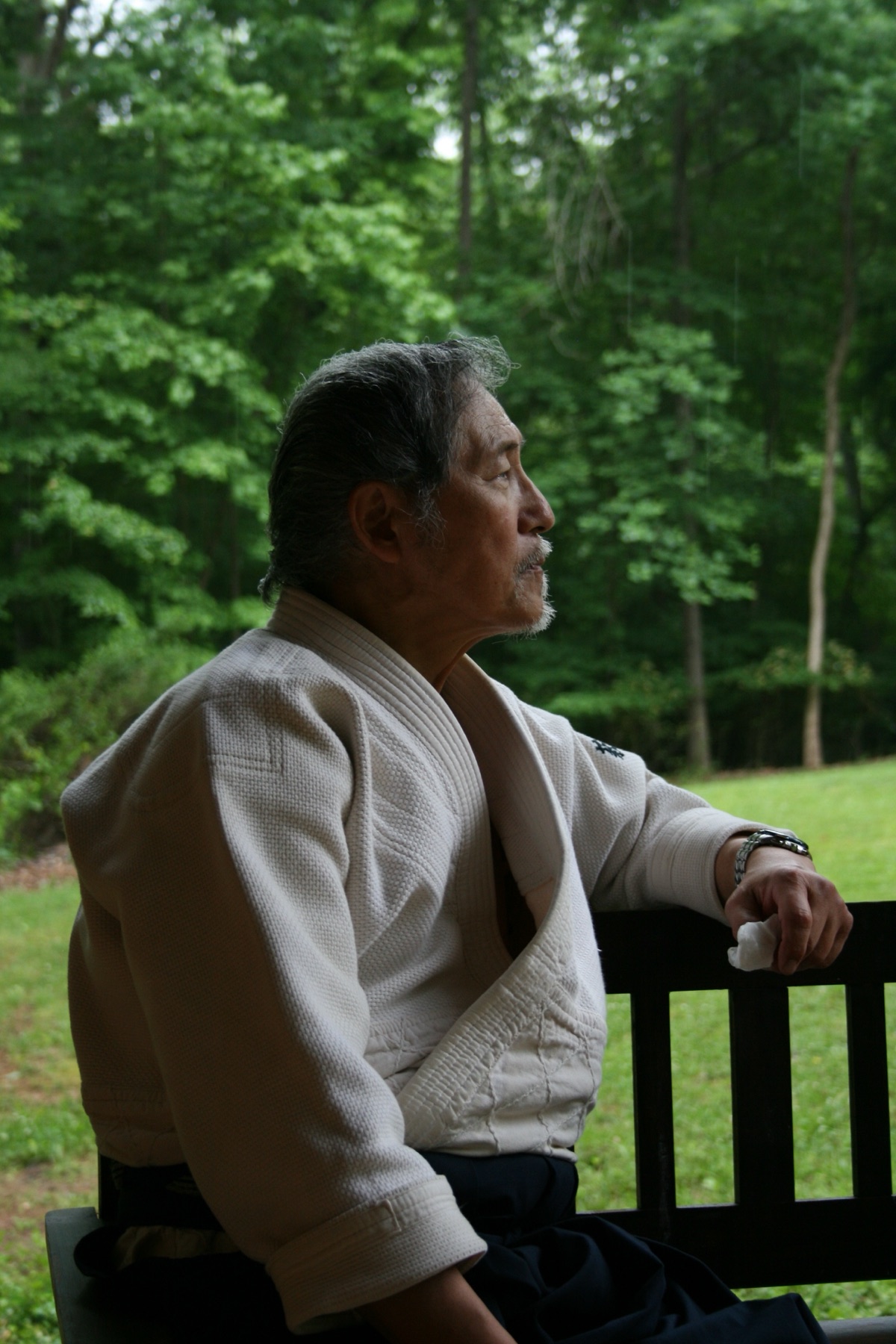
Edward Hagihara was born on 29 March 1935 in New York City to Japanese immigrant parents. His mother had been born in Hawaii and held American citizenship, which allowed the family to settle in the United States. When he was five, with war looming and his mother fearing her children would be sent to a US internment camp, she brought him and his brother to live with their grandparents in Hiroshima — then took the last boat back to the United States to rejoin their father. The brothers remained there through the war, survived the atomic bomb, and returned to New York in 1948.
At seventeen his father introduced him to Judo, which he practised seriously, eventually reaching third dan. Looking for something with more of a spiritual dimension, he discovered Aikido through a book by Koichi Tohei. In the late 1950s he found Yasuo Ohara — a student of Tohei teaching Aikido informally while studying at Columbia — and became his second student.
That group formed the New York Aikikai Ltd, the first Aikido dojo in the continental United States, on 19th Street. Hagihara was one of seven founding members, alongside his wife at the time Virginia Mayhew, Barry Bernstein, Fred Krase and Ralph Glanstein.
When Yasuo Ohara returned to Japan, Hagihara became chief instructor of the New York Aikikai. In 1963 he travelled to Japan himself, to formalise the relationship between the New York Aikikai and Hombu Dojo and to deepen his own training. There he studied under O-Sensei, Kisshomaru Ueshiba and Tohei Sensei — then head of the instructors’ staff — along with instructors who would become legends: Yamaguchi, Tada, Osawa, Arikawa. The uchideshi of that era — Tamura, Yamada, Sugano, Chiba, Saotome — were his daily training partners. He often served as Tohei Sensei’s demonstration partner, in Japan and later in America.
His training in Japan was cut short. Tohei Sensei, who oversaw Aikido in the United States, told him the New York Aikikai was falling apart and asked him to go back. When O-Sensei learned he was returning, he summoned him and said: “Go to New York, and teach my Aikido.”
He returned to New York in 1964 to find the New York Aikikai had changed. Unbeknownst to Hagihara, a visiting student from Hombu Dojo — one he had met in Japan — had come to New York to consider attending university. Instead, he had taken up residence at the New York Aikikai. With many of the original board members and core students having decided to move on, Hagihara relinquished his position as chief instructor and went his own way, founding the Long Island Aikikai — the second Aikido dojo in the continental United States. He taught here until shortly before his death on 13 October 2023, at eighty-eight.
He was present at pivotal moments in Aikido’s development but never sought recognition for any of it. He minimised his own accomplishments and highlighted other people’s. His teaching emphasised love and compassion as the essential qualities of an Aikido practitioner, and he believed Aikido could profoundly change someone — that it would take patience, but that it was possible.
Over the decades many of his students became teachers themselves. Today virtually every traditional Aikido dojo on Long Island traces its roots back to him.
His successor is Adam Pilipshen, his last apprentice, who leads the Long Island Aikikai today.